Creative Logo Design Service in Delhi | Logo Designer in Delhi
Table of Contents
A logo is often the first visual element people notice about a business. Before they read your website, understand your services or speak to your team, your logo can already influence how they perceive your brand.
A professionally designed logo can communicate professionalism, personality, credibility and visual character in a simple and memorable form.
If you are looking for a Logo Design Service in Delhi, you need more than someone who can simply create a symbol, select a font and add a colour.
You need a logo that is created after understanding your business, your audience, your competition and the way your brand will actually be used.
I am Desh Deepak Sachdeva, a professional Logo Designer and Brand Identity Designer with 33+ years of experience in graphic design, branding and visual communication.
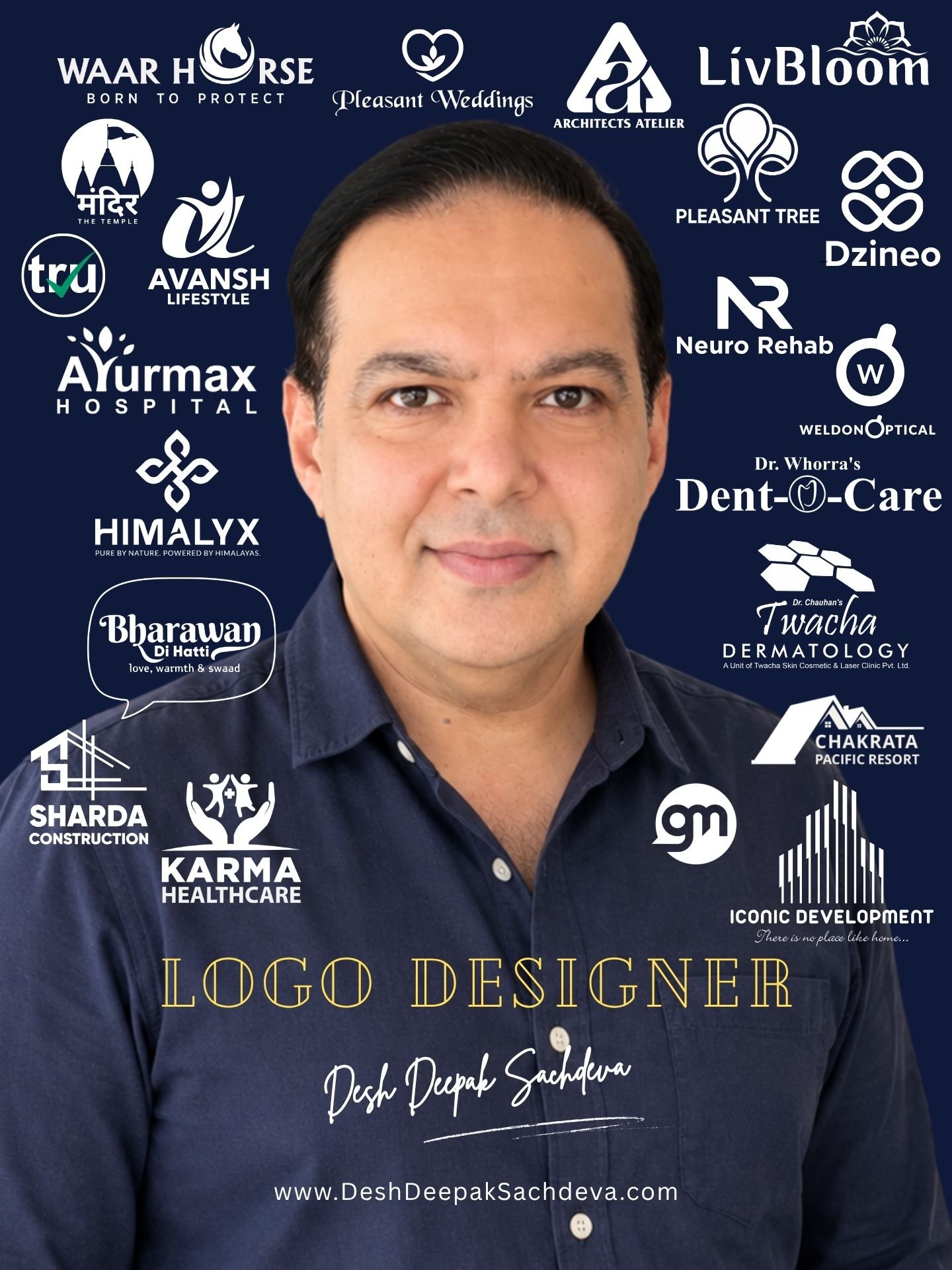
I provide creative logo design services in Delhi and Delhi NCR for startups, entrepreneurs, small businesses, established companies, professionals, institutions and personal brands.
My approach is simple:
A logo should not simply look good. It should make sense for the brand.
Professional Logo Design Service in Delhi
Delhi is home to startups, established companies, professionals, retailers, restaurants, healthcare businesses, real-estate companies, technology companies, consultants, educational institutions, manufacturers and thousands of growing businesses.
In such a competitive environment, your brand needs a visual identity that is distinctive and appropriate for its market.
My logo design service in Delhi focuses on creating logos that are:
- Original and custom-designed
- Relevant to the business
- Simple and memorable
- Professional and distinctive
- Scalable for different sizes
- Suitable for digital and print
- Practical for everyday business use
- Designed with long-term brand recognition in mind
A logo should work on a website just as well as it works on a visiting card, social media profile, office signage, packaging, presentation, advertisement or printed document.
That practical thinking is an important part of professional logo design.
33+ Years of Logo Design & Graphic Design Experience
One of the biggest advantages of working with an experienced designer is not simply the number of years written on a website.
It is what those years teach you about design.
I have spent 33+ years working in graphic design, advertising, branding and visual communication.
During this time, design has changed dramatically.
From traditional print-based design to desktop publishing, digital graphics, websites, social media and today’s digital-first businesses, the way brands communicate has continuously evolved.
But one thing has remained constant:
Good design needs clarity.
Experience teaches a designer when to add something—and, equally importantly, when to remove something.
It teaches you how typography, spacing, proportion, colour and shape work together.
It teaches you that a logo that looks impressive on a large computer screen may not work as a small social media icon.
And it teaches you that a logo should be designed for the real world, not just for a presentation.
Why Choose a Professional Logo Designer in Delhi?
There are thousands of logo templates, online logo makers and AI-based design tools available today.
So why hire a professional logo designer?
Because creating a logo and creating the right logo for a business are two different things.
A professional logo designer looks beyond the graphic.
The process considers:
Your Business
What do you do?
What makes your business different?
What type of image do you want to create?
The answers influence the visual direction of the identity.
Your Target Audience
Who are you trying to reach?
A logo for a children’s education brand should not necessarily communicate in the same visual language as a corporate financial consultancy.
The logo should be appropriate for the people who are expected to recognise and trust the brand.
Your Competition
Your logo should be distinctive within your category.
Looking at competitors helps identify visual patterns that may be overused and opportunities to create something more distinctive.
Research is not about copying competitors.
It is about understanding the visual environment in which the brand will compete.
Your Brand Personality
Should the brand feel:
- Professional?
- Premium?
- Friendly?
- Modern?
- Traditional?
- Innovative?
- Bold?
- Minimal?
- Trustworthy?
The logo should support that personality.
Practical Usage
Where will the logo appear?
- Website?
- Instagram?
- YouTube?
- Visiting card?
- Office signage?
- Packaging?
- Uniform?
- Vehicle?
- Advertisement?
- Product?
- Documents?
The answer affects the way the logo should be constructed.
My Logo Design Process
A professional logo should not begin with randomly drawing symbols.
It should begin with understanding.
1. Understanding Your Business
The first step is understanding what your business does and what you want your logo to communicate.
I look at the business category, positioning, target audience and overall direction of the brand.
2. Understanding the Target Audience
A logo is ultimately created for the people who will see and remember it.
Therefore, the visual language should be appropriate for the intended audience.
3. Research & Visual Direction
Research helps understand the competitive environment and identify common visual patterns.
The objective is not to copy what competitors are doing.
The objective is to understand the category and find an opportunity for differentiation.
4. Concept Development
This is where ideas begin to take visual form.
Depending on the project, the concept may develop through:
- Typography
- Letterforms
- Symbols
- Shapes
- Monograms
- Abstract forms
- Negative space
- Geometric construction
- Combination marks
The important part is that the concept should have a reason behind it.
5. Typography & Colour
Typography is one of the most important elements of a logo.
The right typeface can completely change the personality of a brand.
Similarly, colour can influence how a brand is perceived.
But colour should not be used simply because it looks attractive.
A strong logo should have a clear structure even without depending entirely on colour.
6. Refinement
Once a promising direction is developed, the design is refined.
This can include:
- Letter spacing
- Proportion
- Alignment
- Shape
- Stroke thickness
- Typography
- Symbol construction
- Colour balance
- Negative space
Small adjustments can make a significant difference.
7. Real-World Testing
Before a logo is considered complete, it should be tested in realistic situations.
For example:
- Website header
- Social media profile
- Visiting card
- Letterhead
- Signage
- Packaging
- Advertisement
- Presentation
- Mobile screen
- Small-size application
This helps ensure that the logo is not only attractive but also functional.
Logo Designs Created by Desh Deepak Sachdeva
33+ Years of Design Experience in Every Logo
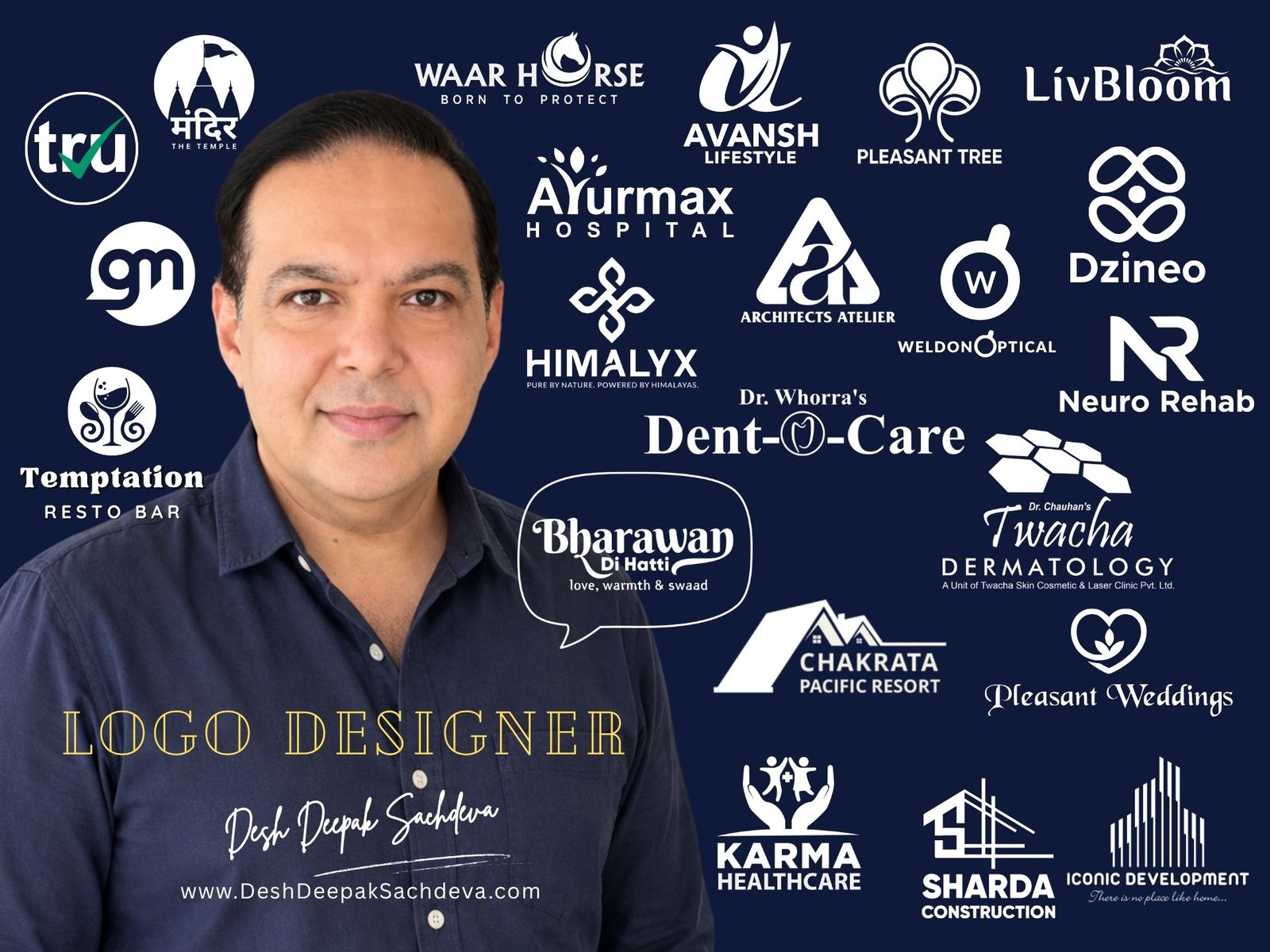
Over the years, I have created logo concepts and visual identities for businesses, brands, professionals and organisations across different industries.
Every logo presents a different design challenge.
Some brands need a simple typographic identity. Some need an iconic symbol. Others require a combination of typography and visual elements.
My objective is not to follow one particular design style.
The objective is to find the visual language that is right for the brand.
The selected logo designs shown here represent my approach to creating identities that are simple, meaningful, distinctive and practical.
What Makes a Good Logo for a Delhi Business?
A good logo does not necessarily need to be complicated.
In fact, some of the strongest identities are remarkably simple.
A professional logo should ideally be:
Simple
People should be able to understand and remember the basic form.
Distinctive
It should have its own visual character rather than looking like another business in the same category.
Relevant
The design should make sense for the brand and its audience.
Memorable
A strong visual form is easier to recognise and recall.
Scalable
The logo should work from a tiny digital icon to a large signboard.
Versatile
It should work across different backgrounds and applications.
Timeless
A logo should not depend completely on a short-lived design trend.
When a Good Logo Concept Is Actually the Wrong Logo
One of the most important lessons experience teaches a designer is that a logo can be technically well designed and still be wrong for the business.
A logo can be beautiful, balanced, modern and scalable—but if it does not fit the brand, its audience or its competitive environment, it may not be the right solution.
This is where professional judgement becomes important.
When Simplicity Becomes Too Generic
Minimalism is popular because simple identities can be easy to remember and reproduce.
But simple does not automatically mean distinctive.
A logo consisting of a basic geometric symbol, a clean sans-serif font and two colours may look professional, but if dozens of competitors use almost the same visual language, the brand may disappear into the category.
The objective should therefore be:
Simple + Distinctive
—not simply:
Simple = Good.
When a Literal Symbol Becomes a Weak Choice
A business does not always need a symbol showing exactly what it does.
A dentist does not necessarily need a tooth.
A restaurant does not necessarily need a fork.
A real-estate company does not necessarily need a building.
A cybersecurity company does not necessarily need a shield.
Literal symbols can sometimes communicate the category quickly, especially for a new business.
But they can also become predictable.
The right question is:
Does this symbol make the brand more distinctive, or does it simply tell people what category the business belongs to?
When Following Industry Trends Can Backfire
If every competitor is using the same visual style, following the trend may make a new brand look familiar—but not memorable.
Trends can be useful references.
They should not automatically become the design strategy.
When the Founder Loves the Logo but the Brand Doesn’t Need It
This happens more often than people realise.
A business owner may have a favourite colour, font, symbol or design style.
Personal preference is important because the owner has to live with the identity.
But the logo also has to work for the customers.
There is a difference between:
“I like this logo.”
and:
“This logo is right for my brand.”
A professional designer should be able to explain that difference.
When a Logo Does Not Need to Explain Everything
A logo does not necessarily have to explain the entire business in one glance.
Some of the world’s strongest identities are not literal descriptions of what the company sells.
Meaning can develop through repeated exposure, consistent branding, customer experience and business reputation.
The logo is an identifier.
It does not have to become an entire business explanation.
The practical lesson
A good logo is not simply the one that looks best on the presentation screen. It is the one that makes sense for the brand and continues to work when the brand enters the real world.
Logo Design for Startups in Delhi
Delhi has a large and continuously evolving startup ecosystem.
For a new business, the logo is often one of the first major branding decisions.
A startup logo needs to establish a visual personality from the beginning.
I can create custom logo designs for:
- New startups
- Technology startups
- D2C brands
- Food startups
- Consulting businesses
- Online businesses
- Service businesses
- Personal brands
- New product brands
A startup does not necessarily need an expensive-looking or complicated logo.
It needs a clear identity that can grow with the business.
A good startup identity should also leave enough room for future growth.
A business may begin with one service and later introduce additional products, categories or sub-brands.
That possibility should be considered when appropriate.
Logo Design for Small Businesses in Delhi
Small businesses compete with larger and more established brands every day.
A professional logo can help create a more consistent and credible visual presence.
Logo design can be created for:
- Retail businesses
- Local shops
- Restaurants
- Cafés
- Salons
- Clinics
- Consultants
- Contractors
- Real-estate businesses
- Educational businesses
- Service providers
- Manufacturers
- Traders
- Professional practices
The objective is to create an identity that represents the business professionally without making the logo unnecessarily complicated.
A small business does not need to imitate a large corporation.
It needs an identity appropriate to its own positioning, customers and ambitions.
Corporate Logo Design in Delhi
Corporate brands often require a different design approach.
A corporate logo may need to work across:
- Corporate websites
- Business cards
- Presentations
- Reports
- Office signage
- Documents
- Social media
- Advertising
- Packaging
- Digital platforms
For such businesses, consistency becomes extremely important.
The logo should be designed as the foundation of a broader visual identity.
Corporate identity also has to survive internal use.
Different departments, employees, printers, vendors and marketing teams may eventually use the logo.
That makes proper artwork, variations and usage rules particularly important.
Logo Design for Delhi NCR Businesses
My logo design services can also be used by businesses across Delhi NCR, including:
- New Delhi
- South Delhi
- North Delhi
- East Delhi
- West Delhi
- Central Delhi
- Noida
- Greater Noida
- Gurugram
- Ghaziabad
- Faridabad
The project can be handled through online communication, meetings, calls and digital collaboration depending on the requirement.
The important thing is not simply where the designer and client are located.
The important thing is understanding the business and creating an identity that works for its intended market.
Logo Designer in South Delhi
Businesses in South Delhi include professionals, restaurants, healthcare providers, real-estate companies, consultants, luxury businesses, startups and established organisations.
A professional logo can help such businesses develop a visual identity appropriate to their positioning.
I provide custom logo design for businesses looking for a more individual and professional identity rather than a generic template-based logo.
Logo Designer in Central Delhi
Central Delhi has businesses across professional services, hospitality, retail, education, institutions and established commercial sectors.
Logo design for such businesses may require a balance between professionalism, recognition and modern visual communication.
The logo should represent the business while remaining practical across both traditional and digital applications.
Logo Design for Businesses in Noida & Gurugram
Delhi NCR businesses are not limited to Delhi itself.
Noida and Gurugram have become major business and technology hubs, with startups, IT companies, consulting firms, real-estate companies, corporate offices and new-age businesses.
I provide logo design services for businesses across Delhi NCR, including Noida, Greater Noida, Gurugram, Ghaziabad and Faridabad.
Designing a Logo for India Is Not the Same as Designing One for a Global Audience
A business based in Delhi may want to look Indian, international, traditional, modern—or a combination of these.
There is no single visual formula for an Indian brand.
The right direction depends on the business.
Local Identity vs Modern Identity
Some brands benefit from communicating a strong connection with Indian culture.
Others may want a contemporary identity that could work equally well in international markets.
Neither approach is automatically better.
The brand’s positioning should decide.
Cultural Symbols Need Context
Colours, symbols, scripts and visual motifs can carry cultural meanings.
They should therefore be used deliberately rather than simply because they “look Indian.”
For a heritage organisation, tourism business or traditional service, cultural symbolism may be highly relevant.
For a technology startup, it may not be necessary.
English, Hindi or Bilingual Identity
Some businesses may benefit from English typography.
Others may need Hindi or bilingual communication because of their audience.
However, trying to place too much information directly inside a logo can make it difficult to reproduce and remember.
Sometimes the better solution is to keep the core logo clean and use supporting language elsewhere in the brand system.
A Delhi Business Does Not Need a “Delhi-Looking” Logo
A business being located in Delhi does not mean its logo needs:
- India Gate
- Red Fort
- Delhi skyline
- Traditional motifs
- Hindi lettering
Local relevance does not always need to be visually literal.
A modern Delhi company can have a modern global-looking identity.
When Local Visual Language Makes Sense
Local or cultural elements may be appropriate when they genuinely support the brand.
Examples can include:
- Cultural institutions
- Heritage businesses
- Tourism
- Traditional services
- Regional food brands
- Community organisations
- Indian-origin product brands
The principle is simple:
Use local symbolism because it serves the brand—not simply because the business is located in Delhi.
Types of Logo Design I Can Create
Different businesses require different types of logo solutions.
Depending on the brand, the logo may be based on:
Wordmark Logo
A logo primarily created using the brand name and carefully designed typography.
Lettermark Logo
A logo based around initials or abbreviated letters.
Monogram Logo
A distinctive symbol constructed using letters or initials.
Symbol / Icon Logo
A visual symbol that can become strongly associated with the brand.
Combination Mark
A combination of symbol and typography.
Abstract Logo
A conceptual visual form rather than a literal representation.
Minimal Logo
A simple and carefully constructed identity using limited visual elements.
Emblem / Badge Logo
A more structured identity often suitable for organisations, institutions, clubs and certain traditional businesses.
The right choice depends on the business—not on which logo style happens to be trending.
Custom Logo Design vs Online Logo Maker
Online logo makers can be useful for experimenting with ideas.
But a professional custom logo is created specifically around your brand.
With a custom logo design approach, the designer can consider:
- Your business
- Your positioning
- Your audience
- Your competition
- Your personality
- Your typography
- Your colour system
- Your future applications
- Your brand identity
The result should not look like a template that could belong to hundreds of other businesses.
Online tools can produce a graphic.
The greater challenge is creating an identity that is appropriate, distinctive and usable over time.
Logo Design & Brand Identity
A logo is an important part of a brand identity—but it is not the entire brand.
A complete brand identity may include:
- Logo
- Colour palette
- Typography
- Business cards
- Letterhead
- Social media graphics
- Packaging
- Signage
- Marketing materials
- Website visuals
- Brand guidelines
That is why I look at logo design from a broader brand identity perspective.
The logo should be able to become the foundation for the brand’s visual communication.
What Should You Receive From a Professional Logo Design Service?
Depending on the agreed project scope, a professional logo project may include final artwork suitable for different applications.
Common requirements include:
- Primary logo
- Alternative logo arrangement
- Black version
- White/reversed version
- Transparent PNG
- High-resolution JPG
- Vector artwork
- Print-ready artwork
- Digital-use files
- Social media applications
- Favicon or small-size version where required
The exact deliverables should always be agreed according to the project.
A logo should not be delivered as just one low-resolution JPG.
For professional business use, scalable/vector artwork is particularly important.
The Logo After Approval: What Happens When It Enters the Real World?
One of the realities of logo design that is rarely discussed is what happens after the client approves the design.
The logo leaves the designer’s computer and starts appearing in the real world.
That is where unexpected problems can appear.
The Same Logo Can Look Different in Different Production Environments
A logo may be reproduced through:
- Digital screens
- CMYK printing
- Offset printing
- Digital printing
- Vinyl signage
- Screen printing
- Embroidery
- Newspaper printing
- Large-format printing
The same colour and fine details do not necessarily behave identically in every medium.
This is one reason a logo should be designed with reproduction in mind.
Small-Size Reproduction Can Expose Weaknesses
A logo may look excellent at a large size and become unclear when reduced.
Fine lines can disappear.
Small text can become unreadable.
Details can merge together.
This is why certain identities may need carefully considered small-size applications or simplified versions.
Vendors Can Accidentally Damage a Logo
In real business use, a logo may eventually be handled by:
- Printers
- Signboard vendors
- Social media designers
- Website developers
- Advertising agencies
- Packaging suppliers
- Employees
If the correct artwork is not supplied, someone may stretch the logo, substitute a font, change the colour or recreate it from a low-resolution image.
The problem is not always bad intention.
Sometimes the problem is simply that the correct master artwork was never available.
Different Backgrounds Need Different Treatments
A professional identity may need:
- Full-colour version
- Black version
- White/reversed version
- Light-background version
- Dark-background version
- One-colour version
These variations are not necessarily different logos.
They are different applications of the same identity.
The Logo Becomes a System
This is the important distinction.
The final deliverable is not simply:
“Here is your JPG.”
It should be an identity that can be reproduced correctly by the people who will use it.
The practical logo lifecycle
Concept → Approval → Master Artwork → Variations → Production → Implementation → Quality Control
A logo is successful when it continues to look like the same brand after passing through all those stages.
Advanced Logo Identity System: Designing for Scale, Variations & Future Growth
For a small project, a simple logo may be all that is required.
But as a business grows, the identity often needs to become a more structured system.
This is where logo design moves beyond creating a single mark.
Responsive Logo Architecture
A mature identity may require different expressions of the same logo.
For example:
Full Logo
Brand name + symbol
↓
Compact Logo
Reduced arrangement
↓
Symbol / Icon
Visual mark only
↓
Small-Size Version
Designed for very small applications
These should not look like four unrelated logos.
They should feel like parts of the same identity system.
Designing for Future Brand Extensions
A business may eventually launch:
- New products
- Additional services
- Product ranges
- Sub-brands
- Premium versions
- Digital products
- New divisions
The original identity should be considered in the context of potential growth where appropriate.
Not every small business needs a complex brand architecture.
But growing businesses should avoid making decisions that unnecessarily restrict future development.
Colour Architecture
Instead of thinking only:
“My logo is blue.”
An identity system can consider:
- Primary colour
- Secondary colour
- Background colours
- Reversed application
- Monochrome use
- Digital values
- Print values
This becomes particularly useful when multiple people produce marketing material.
Typography Beyond the Logo
The typeface used in the logo does not always need to be the same typeface used throughout the brand.
A brand can have:
Logo Typography
Supporting Brand Typography
Digital/UI Typography
This provides flexibility while preserving the identity of the logo.
The Handover Problem
After a logo project is completed, the original designer may not be the person creating every future social post, website banner, advertisement, presentation or printed item.
The identity therefore needs enough documentation to help others use it correctly.
That is where a brand guide or usage guide can become useful.
It does not necessarily need to be a huge document.
The important thing is that the rules are practical and understandable.
Logo vs Logo Identity System
A logo is a visual mark.
A logo identity system is the framework that allows that mark to remain recognisable and consistent across different sizes, formats, backgrounds and applications.
That distinction becomes increasingly important as a business grows.
Why Your Logo Must Work Without Colour
This is one of the tests I consider important in logo design.
Imagine your logo printed:
- In black and white
- On a newspaper
- On a photocopy
- On a rubber stamp
- On a single-colour print
- On a dark background
If the identity completely falls apart without colour, the underlying design may need more work.
Colour should enhance a good logo—not be the only thing making it work.
Why Real-World Logo Testing Matters
A logo shown on a beautiful presentation mockup can look impressive.
But real business use is different.
Your logo may eventually appear:
2 cm wide on a document.
At a small size on a website.
On an Instagram profile.
On an office signboard.
On a visiting card.
On packaging.
On a vehicle.
On an advertisement.
On uniforms or merchandise.
This is why I believe a logo should be designed for real-world use, not just for presentation.
Logo Design Myth vs Reality: What 33+ Years in Design Has Taught Me
After working in graphic design and visual communication for more than three decades, I have seen many assumptions about what makes a logo successful.
Some contain a little truth.
Others are simply repeated because they sound good.
Here are some important distinctions.
Myth: A Good Logo Must Explain Exactly What the Company Does
Reality
Not necessarily.
A logo can be an identifier rather than an illustration of the business.
Its meaning can develop through consistent use and the reputation of the brand.
Myth: More Logo Concepts Mean Better Design
Reality
More concepts do not automatically mean more creativity.
Twenty variations of the same weak idea are not necessarily better than a small number of genuinely considered directions.
The quality of the thinking matters more than the quantity of options.
Myth: A Modern Logo Must Follow Current Design Trends
Reality
A trend can make a logo look contemporary.
But trends change.
A logo should be appropriate for the brand first.
Modern does not necessarily mean trendy.
Myth: The Most Expensive Logo Is Automatically the Best
Reality
Price alone does not determine creative quality.
The scope of work, research, design thinking, experience, refinement and final deliverables all matter.
A simple logo project and a complete identity system are not equivalent projects.
Myth: A Logo Needs Lots of Hidden Meaning
Reality
A designer can sometimes over-engineer a logo by trying to put too many messages into one symbol.
Meaning is valuable.
But clarity should not be sacrificed simply to make the design story sound clever.
Myth: The Logo Should Make Everyone Say “Wow” Immediately
Reality
A logo is not necessarily designed to win a design competition.
It has to serve a business.
A logo that is visually dramatic but difficult to reproduce, remember or use may not be a successful identity.
The better question is:
Will this logo continue to work for the brand?
Logo Redesign Service in Delhi
Sometimes you don’t need a completely new logo.
Your existing logo may already have recognition.
But perhaps:
- It looks outdated.
- It doesn’t work well digitally.
- The typography needs improvement.
- The colours are inconsistent.
- It doesn’t scale properly.
- It looks too complicated.
- It no longer represents the business.
- The business has changed direction.
In such situations, a logo redesign or logo refresh may be a better solution than completely abandoning the existing identity.
The goal can be to retain useful brand recognition while improving the visual system.
When Should You Change Your Logo?
A logo does not need to be changed simply because it is old.
Consider redesigning when the existing identity:
- No longer represents the business
- Looks dated or inconsistent
- Is difficult to reproduce
- Does not work digitally
- Is too complicated
- Is visually similar to competitors
- Does not communicate the desired positioning
- Has become difficult to use across modern platforms
A good redesign should have a reason behind it.
Sometimes the right answer is a complete redesign.
Sometimes it is a careful refresh.
And sometimes the best decision is to keep the existing logo and improve the surrounding brand system.
It depends on how much useful recognition the existing identity already has.
How Much Does Logo Design Cost in Delhi?
There is no single price for professional logo design.
The cost depends on the scope and requirements of the project.
Factors can include:
- Complexity of the logo
- Research required
- Number of concepts
- Revision requirements
- Typography development
- Custom illustration
- Brand identity requirements
- Number of final variations
- Brand guidelines
- Additional stationery or marketing requirements
A simple standalone logo and a complete brand identity project are two very different requirements.
I recommend discussing your business and requirements before deciding the appropriate scope for the project.
A useful way to think about logo pricing is not simply:
“How much does a logo cost?”
but:
“What exactly does the business need from its visual identity?”
A startup that needs only a basic logo has a different requirement from a growing company that needs a complete identity system across packaging, website, signage, social media and stationery.
Who Can Hire Me for Logo Design in Delhi?
My logo design services can be suitable for:
- Startups
- Entrepreneurs
- Small businesses
- Corporate companies
- Manufacturers
- Retail businesses
- Restaurants and cafés
- Healthcare businesses
- Educational institutions
- Real-estate companies
- IT companies
- Consultants
- Professionals
- Personal brands
- E-commerce businesses
- NGOs and organisations
- New product brands
- Existing businesses looking for a redesign
Whether you are launching a new business or improving an existing identity, the logo should be designed according to the brand’s actual requirements.
How to Choose the Right Logo Designer in Delhi?
Before hiring a logo designer, don’t look only at the price.
Look at the quality of thinking and design work.
1. Portfolio
Look at actual logo work.
Do the logos demonstrate different types of thinking, or do they all look like variations of the same template?
2. Experience
Understand how long the designer has been working in the field.
Experience is not everything, but it can provide valuable perspective about design, production and real-world application.
3. Design Approach
Does the designer understand your business before designing?
A good briefing can prevent a great deal of unnecessary design work later.
4. Originality
Are the logos genuinely custom or template-based?
This matters particularly when the logo is expected to become a long-term business asset.
5. Practicality
Does the logo work across different sizes and applications?
A presentation mockup alone cannot answer this.
6. Communication
Can you communicate your ideas and receive professional design guidance?
The best logo projects are collaborative without turning the client into the designer.
7. Final Deliverables
Make sure you understand what files and variations you will receive.
A professional logo should be supplied in formats appropriate to its intended use.
What Happens When a Logo Needs to Work at Many Sizes?
This is a practical question that many new businesses do not consider.
Your logo may appear on a huge office signboard and, on the same day, as a tiny profile image.
At large size, details may be visible.
At very small size, those same details may disappear.
This is why scalability should not mean simply:
“The vector file can become bigger.”
Vector artwork allows a logo to scale technically.
But visual scalability is different.
A logo can be technically scalable but visually unsuitable at very small sizes.
That is why testing matters.
The question is not only:
“Can we make it bigger or smaller?”
It is:
“Does it still communicate clearly at that size?”
A Logo Should Serve the Brand, Not the Other Way Around
A common mistake in branding is becoming emotionally attached to a particular design direction simply because it looks attractive.
Design is important.
But the business comes first.
The logo should support:
- The brand’s positioning
- The intended audience
- Recognition
- Communication
- Consistency
- Practical usage
- Future development
Sometimes the strongest design decision is not adding another visual element.
Sometimes it is removing one.
That is one of the lessons that years of design work teaches.
Why 33+ Years of Experience Matters
There are many talented young designers today.
Experience does not automatically make someone a better designer.
But 33+ years of working in design does provide something valuable:
Perspective.
After working through different design eras, industries, technologies and communication mediums, you begin to understand that good branding is not about adding more.
It is about finding the right balance.
A logo needs to communicate.
It needs to be recognisable.
It needs to work technically.
It needs to survive different applications.
And most importantly, it needs to serve the brand.
That is the perspective I bring to every logo design project.
Looking for a Logo Design Service in Delhi?
If you are starting a new business, launching a new brand or redesigning an existing identity, I would be happy to discuss your requirements.
I am Desh Deepak Sachdeva — Professional Logo Designer & Brand Identity Designer with 33+ years of design experience.
My approach is focused on creating logos that are:
Simple. Distinctive. Meaningful. Practical.
Whether you need a logo for a startup, small business, corporate company, professional practice or personal brand, the objective remains the same:
Create an identity that represents the brand—not simply a graphic that looks good.
Looking for a creative Logo Design Service in Delhi? Let’s discuss your brand.
Desh Deepak Sachdeva
Professional Logo Designer & Brand Identity Designer
33+ Years of Design Experience
Frequently Asked Questions
What is a professional logo design service?
A professional logo design service involves creating a custom visual identity for a business after understanding its business, audience, positioning and practical requirements.
How much does logo design cost in Delhi?
Logo design pricing varies depending on the scope, complexity, concepts, revisions, deliverables and whether you require only a logo or a broader brand identity.
How long does logo design take?
The timeline depends on the project scope, design requirements and revision process. A simple logo project and a complete brand identity project can have very different timelines.
Do you provide custom logo design?
Yes. The focus is on creating a logo specifically for the individual business rather than simply using a ready-made template.
Can you redesign an existing logo?
Yes. An existing logo can be refreshed or redesigned when the business needs a more modern, practical or relevant identity.
Do you provide logo files for printing and digital use?
Final deliverables can be prepared according to the project’s requirements, including formats suitable for digital and print applications.
Do you provide logo design services outside Delhi?
Yes. Although this page focuses specifically on logo design services in Delhi and Delhi NCR, projects can also be handled remotely for businesses in other cities and locations.
What makes a good logo?
A good logo should be distinctive, memorable, relevant, scalable and practical. It should communicate the brand without unnecessary complexity.
Why is professional logo design important?
A logo becomes an important visual identifier for a business. A thoughtfully designed identity can help create consistency and recognition across different brand touchpoints.
Can a logo be designed for a startup?
Yes. Startups can benefit from a clear visual identity that establishes their brand personality and provides a foundation for future branding.
Does a logo need to explain what a business does?
Not necessarily. A logo primarily acts as a visual identifier. Its meaning can develop through consistent use, communication and the reputation of the brand.
Is a minimalist logo always better?
No. Minimalism can improve clarity and scalability, but excessive simplification can also make a logo generic. The right level of simplicity depends on the brand.
Should a business redesign an old logo?
Not necessarily. A logo should be redesigned when there is a genuine business, positioning, recognition or practical reason to do so. Sometimes a refresh is more appropriate than a complete redesign.
What is the difference between a logo and a brand identity?
A logo is an important visual identifier. A brand identity is the broader system that can include the logo, colours, typography, layouts, applications and usage rules.
Why are vector logo files important?
Vector artwork can be scaled for different applications without becoming dependent on a fixed pixel resolution. This makes it particularly useful for professional print and production requirements.
Final Thought
A logo may be a small part of a business visually, but it can become one of the most consistently used elements of its identity.
It may appear on your website, social media, visiting cards, documents, packaging, signage, advertising and many other places.
That is why I believe logo design should not be treated simply as the creation of a graphic.
It should be treated as the creation of a visual identity that has to work repeatedly, consistently and practically over time.
With 33+ years of experience in graphic design, advertising, branding and visual communication, my approach is to create logos that are not only visually appealing, but also relevant to the brand and practical in the real world.
If you are looking for a Creative Logo Design Service in Delhi, let’s discuss your brand and create an identity that makes sense for your business.
Desh Deepak Sachdeva
Professional Logo Designer & Brand Identity Designer
33+ Years of Design Experience
Phone: +91-8979777999
Email: dds@deshdeepaksachdeva.com
Follow : Instagram and Facebook
Also Read