
Digital Marketing for Doctors in India: What Actually Works in 2026 (And What Usually Fails)
Table of Contents
The best doctor in a city is not always the doctor getting the most patients online.
I have seen highly experienced doctors with excellent clinical reputation struggle digitally, while newer clinics dominate Google search results simply because they understand patient psychology, local SEO, trust-building, and digital visibility more effectively.
That is the biggest shift happening in Indian healthcare today.
Patients no longer choose doctors only through referrals or offline reputation. Before booking an appointment, many patients now:
- search on Google,
- compare clinics,
- read reviews,
- visit websites,
- watch videos,
- and evaluate trust signals within minutes.
In many specialties, the first consultation now begins digitally long before the patient enters the clinic.
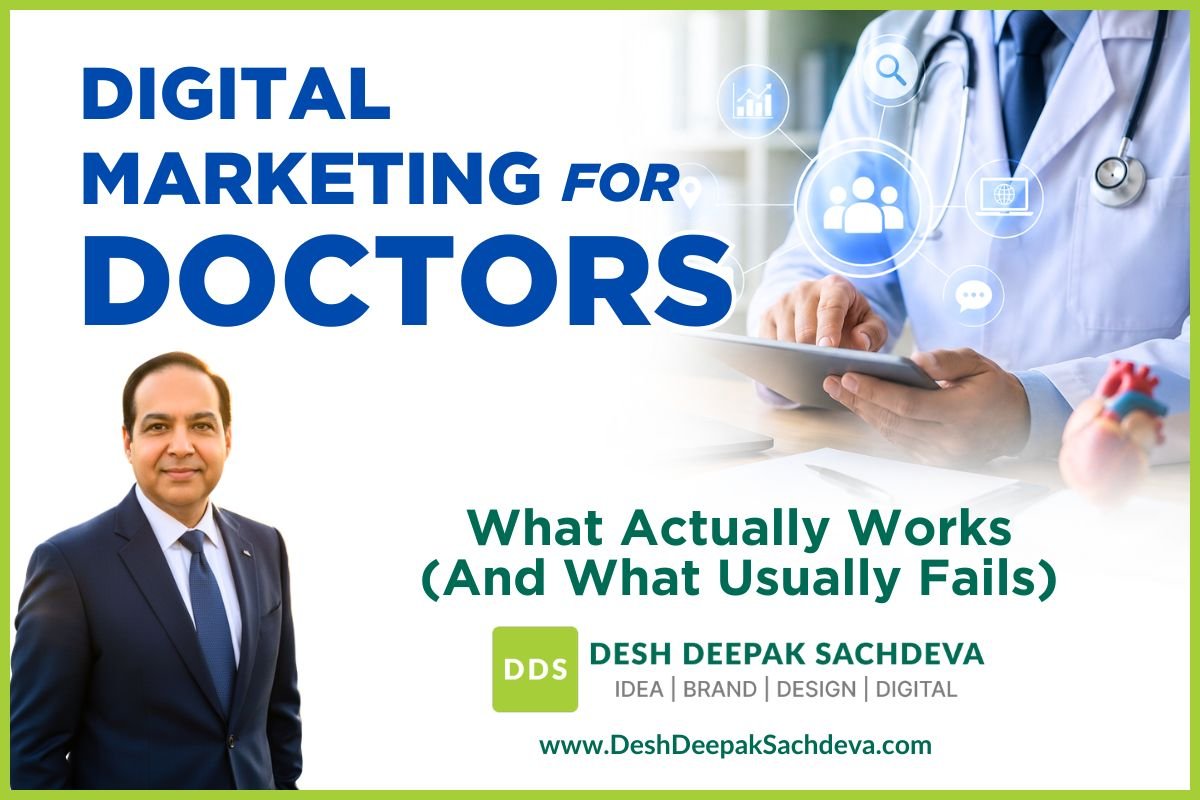
I am Desh Deepak Sachdeva, a healthcare digital marketing consultant and brand strategist with over 32 years of experience in branding, advertising, SEO, and strategic communication.
Over the years, I have worked with healthcare professionals, clinics, hospitals, and medical brands across India and observed one important reality repeatedly:
Digital visibility and medical expertise are not the same thing.
That is why digital marketing for doctors is no longer optional in India’s competitive healthcare environment.
Why Most Doctors Struggle With Digital Marketing
One of the biggest mistakes doctors make is assuming that clinical excellence automatically translates into online growth.
It does not.
Google cannot directly measure how skilled a doctor is inside the consultation room. Instead, Google evaluates digital trust signals such as:
- website quality,
- online reviews,
- local relevance,
- content depth,
- engagement,
- branding consistency,
- authority signals,
- and user experience.
This creates what I call the “Invisible Expert Problem.”
I have seen senior doctors with:
- 20+ years experience,
- excellent patient outcomes,
- and strong offline reputation
lose online visibility to newer clinics simply because:
- their websites were outdated,
- their Google Business Profiles were inactive,
- their reviews were inconsistent,
- or their digital communication lacked clarity.
In healthcare, perception influences trust.
And trust influences patient action.
The Biggest Misconception About Healthcare SEO
Many agencies sell healthcare SEO like a shortcut formula:
- rank #1,
- get traffic,
- receive patients.
Real healthcare SEO is far more complicated.
Healthcare belongs to Google’s YMYL category (“Your Money or Your Life”), which means Google applies stricter quality evaluation because medical information can affect people’s health decisions.
This is why many clinics fail despite publishing large amounts of content.
Google increasingly evaluates:
- expertise,
- topical authority,
- trustworthiness,
- factual consistency,
- website quality,
- and user satisfaction.
Thin AI-written blogs stuffed with keywords rarely perform sustainably anymore, especially in healthcare.
How Indian Patients Are Choosing Doctors Differently Today
Patient behavior in India has changed rapidly due to smartphone adoption, affordable internet access, Google Maps usage, and increasing digital healthcare awareness.
Today, many patients research doctors online before booking consultations.
In practical terms, this means patients often evaluate:
- Google reviews,
- clinic ratings,
- website professionalism,
- treatment explanations,
- doctor visibility,
- and local search presence
before making contact.
Mobile behavior has also changed healthcare discovery significantly.
Many healthcare searches now happen through:
- Google Maps,
- “near me” searches,
- voice searches,
- and mobile-first local browsing.
This shift is especially visible in:
- dermatology,
- dentistry,
- IVF,
- physiotherapy,
- cosmetic treatments,
- and wellness-focused specialties.
One major pattern has become increasingly clear:
Patients trust doctors who educate clearly online.
Clinics publishing:
- FAQs,
- treatment explainers,
- educational videos,
- and patient-focused content
often build stronger trust compared to clinics relying only on promotional advertising.
This is one of the biggest reasons healthcare content marketing has become so important for long-term patient acquisition in India.
What Patients Actually Evaluate Before Choosing a Doctor
Most clinics focus excessively on traffic numbers.
Patients focus on trust.
This difference is critical.
From real-world observation, patients usually evaluate five things before contacting a clinic.
1. Does the doctor look trustworthy?
Patients subconsciously evaluate:
- website professionalism,
- doctor photos,
- communication tone,
- clinic presentation,
- and visual consistency.
Overly aggressive marketing often reduces trust.
Healthcare branding should feel:
- calm,
- professional,
- educational,
- and reassuring.
Not sales-heavy.
2. Are the reviews believable?
Indian patients have become smarter about fake reviews.
A clinic with:
- 400 perfect 5-star reviews,
- repetitive wording,
- and no detailed patient experiences
often creates suspicion rather than trust.
In many cases, 50 authentic reviews outperform 500 manipulated ones.
Patients specifically look for:
- detailed experiences,
- response quality,
- treatment clarity,
- and consistency over time.
3. Is the clinic visible locally?
Local SEO matters enormously in healthcare.
Patients rarely search:
- “best doctor in the world.”
They search:
- “best dentist near me,”
- “skin specialist in Delhi,”
- “orthopedic doctor nearby.”
Google Maps visibility often generates more appointments than social media marketing.
Yet many clinics still neglect:
- Google Business Profile optimization,
- local citations,
- map consistency,
- and local keyword targeting.
4. Does the doctor explain things clearly?
Patients trust educational clarity.
Doctors who explain:
- conditions,
- procedures,
- recovery expectations,
- risks,
- and treatment logic
usually build stronger digital authority.
This is why educational content marketing works exceptionally well in healthcare.
Not because blogs magically rank.
But because education reduces patient anxiety.
5. Is the website easy to use on mobile?
In India, most healthcare searches now happen on mobile devices.
A slow or confusing mobile experience destroys conversion rates.
Common problems include:
- difficult appointment booking,
- cluttered layouts,
- poor loading speed,
- excessive popups,
- and weak navigation.
Patients leave quickly when digital friction increases.
Why Generic Social Media Marketing Fails for Doctors
Many healthcare agencies use the same social media strategy for every clinic.
This rarely works long-term.
Different specialties require completely different communication styles.
Dermatologists and Cosmetic Clinics
These specialties perform well visually because:
- before-after education,
- skincare awareness,
- treatment demonstrations,
- and aesthetic branding
work naturally on Instagram and YouTube.
IVF Clinics
IVF marketing requires emotional sensitivity.
Aggressive advertising often backfires because fertility decisions involve:
- emotional vulnerability,
- family pressure,
- trust,
- privacy concerns,
- and financial stress.
Educational guidance performs far better than promotional campaigns.
Dentists
Dental clinics often benefit heavily from:
- local SEO,
- Google Maps,
- reviews,
- treatment explainers,
- and reputation management.
Many dentists over-invest in Instagram while under-investing in local search visibility.
That is usually a strategic mistake.
Surgeons and Physicians
For many senior consultants, authority-building matters more than “social media popularity.”
Patients trust:
- conference participation,
- educational videos,
- publications,
- FAQs,
- and expertise-driven branding
far more than trendy reels.
Practo vs Google SEO: What Most Clinics Misunderstand
Many Indian clinics become overly dependent on third-party healthcare platforms like:
- Practo,
- Lybrate,
- Justdial,
- and similar directories.
These platforms can help visibility initially.
But there is a hidden problem.
You do not truly own your patient acquisition there.
The platform controls:
- rankings,
- visibility,
- competition placement,
- and lead distribution.
Long-term healthcare branding should focus on building:
- your own website authority,
- your own Google rankings,
- your own reputation ecosystem,
- and your own brand searches.
Otherwise, clinics remain dependent on rented visibility.
This is one of the most overlooked realities in healthcare digital marketing in India.
Real-World Healthcare Marketing Examples From Indian Clinics
One of the biggest mistakes in healthcare digital marketing is assuming that every clinic requires the same strategy.
In reality, different specialties, cities, patient demographics, and treatment types produce completely different online behaviors.
Over the years, I have observed that the clinics generating sustainable long-term growth usually focus more on trust-building than aggressive promotion.
Case Study 1: Dermatology Clinic in Mumbai Struggling Despite Heavy Instagram Activity
A dermatology clinic in Mumbai was posting daily Instagram content consistently for almost eight months:
- reels,
- skincare tips,
- before-after visuals,
- and influencer collaborations.
Engagement looked impressive on the surface.
However, appointment conversions remained inconsistent.
After analysis, the main issue became clear:
the clinic had strong social visibility but weak Google intent visibility.
Patients searching:
- “best dermatologist near me”
- “skin specialist in Mumbai”
- “acne treatment clinic”
were mostly discovering competitors through Google Maps and local SEO instead.
The clinic eventually shifted focus toward:
- Google Business optimization,
- treatment-focused landing pages,
- local SEO,
- review strategy,
- and patient FAQ content.
Within approximately five months, appointment quality improved noticeably because the clinic started capturing high-intent local searches instead of depending heavily on social media reach alone.
This is a common issue in Indian healthcare marketing:
high engagement does not always mean high patient conversion.
Case Study 2: Dentist in Pune Ranking Poorly Despite a Premium Website
A dental clinic in Pune had invested heavily in:
- premium website design,
- animations,
- expensive visuals,
- and branded graphics.
But the website still struggled to rank locally.
The problem was not design quality.
The real issue was weak topical depth.
The website lacked:
- procedure-specific pages,
- FAQ content,
- city relevance,
- review consistency,
- and educational treatment content.
Google increasingly rewards topical completeness in healthcare SEO.
After restructuring the website around:
- dental implants,
- root canal treatment,
- braces,
- smile design,
- recovery FAQs,
- and local intent pages,
organic visibility improved gradually over the next few months because the site became more contextually useful for actual patient searches.
This highlights an important healthcare SEO reality:
A beautiful medical website without topical authority often underperforms a simpler but more informative competitor.
Case Study 3: IVF Clinic Reducing Ad Spend Through Educational Content
An IVF clinic in Delhi was heavily dependent on paid advertising for patient acquisition.
The clinic generated leads consistently through Google Ads, but cost per consultation kept increasing due to rising competition.
Instead of scaling ad budgets endlessly, the strategy shifted toward educational authority-building.
The clinic began publishing:
- fertility FAQs,
- treatment explainers,
- emotional guidance content,
- success process explanations,
- and realistic expectation-based educational videos.
Over time, branded searches increased noticeably.
Patients began discovering the clinic organically through:
- informational searches,
- YouTube education,
- and long-tail fertility questions.
This gradually reduced dependency on paid acquisition alone.
One important insight became very clear:
In emotionally sensitive specialties like IVF, educational trust-building often outperforms aggressive advertising long-term.
The Real Difference Between Normal SEO and Healthcare SEO
Healthcare SEO is psychologically driven.
Most traditional SEO discussions focus on:
- keywords,
- backlinks,
- and rankings.
Healthcare SEO additionally depends on:
- trust architecture,
- patient anxiety reduction,
- expertise perception,
- review quality,
- local authority,
- and communication clarity.
That is why healthcare websites require different content structures.
Good healthcare pages usually answer:
- Is this treatment safe?
- What are the risks?
- How long is recovery?
- What happens if treatment is delayed?
- Is the doctor experienced?
- Is the clinic trustworthy?
Many SEO agencies optimize only for search engines.
Good healthcare SEO optimizes for patient reassurance.
When Google Ads Work Well for Doctors — And When They Waste Money
Google Ads can generate excellent healthcare leads.
But only under the right conditions.
Google Ads usually work well when:
- treatment intent is high,
- search demand is strong,
- location targeting is precise,
- landing pages are trustworthy,
- and appointment systems are optimized.
However, many clinics waste budgets because:
- keywords are too broad,
- targeting is weak,
- landing pages are poor,
- or campaigns attract low-quality traffic.
For example:
“cheap dentist near me”
and
“best dental implant specialist”
represent completely different patient psychology.
High-ticket healthcare services require strategic filtering, not maximum clicks.
Why Reputation Management Is Becoming More Important Than SEO
Ten years ago, ranking on Google was often enough.
Today, ranking alone does not guarantee patient acquisition.
Patients now compare:
- reviews,
- doctor behavior,
- clinic communication,
- online reputation,
- and patient feedback quality.
This means reputation management directly affects conversion rates.
One poorly handled review can influence dozens of future patient decisions.
Professional healthcare reputation management includes:
- response strategy,
- review monitoring,
- trust rebuilding,
- patient communication systems,
- and ethical feedback collection.
Fake review manipulation is becoming increasingly risky and easier for patients to identify.
The Future of Digital Marketing for Doctors in India
Indian healthcare marketing is entering a trust-first era.
The clinics that will dominate over the next few years are not necessarily the loudest marketers.
They will be the clinics that build:
- genuine authority,
- educational depth,
- strong local visibility,
- authentic reputation,
- and patient confidence.
Future healthcare growth will increasingly depend on:
- Google Maps authority,
- video education,
- topical expertise,
- brand trust,
- patient experience,
- and high-quality healthcare content.
The era of shortcut SEO in healthcare is ending rapidly.
Frequently Asked Questions
How long does SEO for doctors take in India?
SEO for doctors in India usually takes approximately 4–8 months to show strong ranking improvement in competitive cities.
Healthcare SEO takes longer because Google applies stricter trust and quality evaluation to medical websites under YMYL guidelines.
Is Instagram necessary for all doctors?
No. Instagram works exceptionally well for visually driven specialties like dermatology, dentistry, aesthetics, and wellness brands. Many other specialties benefit more from local SEO and Google Maps optimization.
Are Google Ads good for doctors?
Yes, but only when campaigns are strategically structured. Poor healthcare PPC campaigns often waste budgets and attract low-quality leads.
What matters more: SEO or reputation?
Today, both are interconnected. SEO generates visibility, but reputation determines conversion.
What is the biggest mistake clinics make online?
The biggest mistake is over-focusing on marketing tactics while ignoring patient trust psychology.
About Desh Deepak Sachdeva
I am Desh Deepak Sachdeva, a healthcare digital marketing consultant and brand strategist in India with over 32 years of experience in branding, advertising, SEO, and strategic marketing.
My work focuses on helping:
- doctors,
- clinics,
- hospitals,
- healthcare startups,
- and medical brands
build long-term digital authority through:
- healthcare SEO,
- branding,
- local search optimization,
- reputation management,
- website strategy,
- and trust-focused communication.
I believe healthcare marketing should never feel manipulative.
The purpose of digital marketing for doctors should not be:
- artificial hype,
- vanity metrics,
- or misleading promotion.
Real healthcare growth happens when clinics build:
- trust,
- clarity,
- consistency,
- patient confidence,
- and educational authority.
The doctors who succeed long-term online are usually not the loudest marketers.
They are the ones who become the most trusted.
Desh Deepak Sachdeva
Healthcare Digital Marketing Consultant in India
9, Vijay Park, Ballupur Road
Dehradun – 248001, Uttarakhand
Phone: +91-8979777999
Email: dds@deshdeepaksachdeva.com
Follow : Instagram and Facebook
Website Designer in Delhi – Professional Freelance Web Designer in Delhi